

Recent trends show a significant increase in the use of combination therapies for advanced cancer, highlighting the need for ongoing education and adaptation.
Recent trends show a significant increase in the use of combination therapies for advanced cancer, highlighting the need for ongoing education and adaptation.
Experts discuss the complexities of advanced imaging in cancer diagnosis, highlighting challenges with PET scans and the importance of accurate interpretation.
In this episode, ‘Strategic Use of ADT in mCSPC From Selection to Escalation,’ the multidisciplinary panelists explore the following questions: With multiple generations of ADT now available in advanced prostate cancer, including oral and injectable options, how do you determine which patients are appropriate candidates for which formulation of ADT? When selecting ADT as the backbone for doublet therapy in metastatic castration-sensitive prostate cancer (mCSPC), in which patients do you prefer the oral versus the injectable option? Which androgen receptor pathway inhibitor (ARPI) do you initiate first? Please explain your rationale. In mCSPC, how do you decide when to escalate from ADT–ARPI doublet to triplet therapy, and what patient or disease factors most influence that decision? How do you weigh potential benefits against added toxicity and contraindications? How does cumulative toxicity influence your willingness to escalate therapy or modify treatment plans?
Welcome back to another Urology Times Peer Exchange series. In this episode titled, ‘Treatment Selection in Advanced Prostate Cancer’, Drs. Paul Sieber, Alicia Morgans, Neeraj Agarwal, and Chad Ritch discussed the following question: When developing treatment plans for prostate cancer, what factors influence treatment selection?
Explore the evolving landscape of immunotherapy in prostate cancer, focusing on personalized treatments and innovative combination strategies.
Explore the evolving landscape of prostate cancer treatment, focusing on personalized immunotherapy and effective patient management strategies.
Experts discuss the importance and limitations of real-world evidence in assessing cardiovascular risks associated with ARPIs, emphasizing the need for critical analysis.
Experts discuss the importance of managing cardiovascular health and bone health in prostate cancer treatment, emphasizing real-world data and patient care strategies.
Long-term data on sipuleucel-T reveals significant survival benefits, emphasizing the importance of multiple lines of therapy in patient outcomes.
Experts discuss the importance of early treatment with Provenge for prostate cancer, highlighting patient demographics and response variability.
Explore the complexities of treating mCRPC with personalized immunotherapies, addressing comorbidities and patient response challenges.
Healthcare professionals discuss adapting treatment guidelines based on genomic testing, emphasizing early detection and personalized care for high-risk patients.

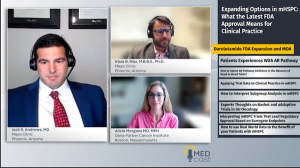
Panelists discuss how the recent FDA approval of darolutamide for metastatic hormone-sensitive prostate cancer (mHSPC) expands treatment options, offering improved tolerability with lower fatigue rates and fewer central nervous system adverse effects than other androgen pathway inhibitors, while exploring considerations for patient selection, trial design interpretation, and the evolving role of real-world evidence in clinical decision-making.
Panelists discuss how the recent FDA approval of darolutamide for metastatic hormone-sensitive prostate cancer (mHSPC) expands treatment options, offering improved tolerability with lower fatigue rates and fewer central nervous system adverse effects than other androgen pathway inhibitors, while exploring considerations for patient selection, trial design interpretation, and the evolving role of real-world evidence in clinical decision-making.
The experts discuss how recent therapeutic advances and trial data are reshaping standard care in advanced prostate cancer.
Alicia Morgans, MD, MPH, and Paul Sieber, MD, introduce the discussion, outlining goals to connect evolving mCRPC research with personalized immunotherapy practice.
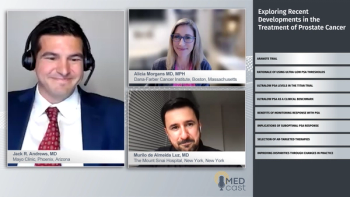
Jack R. Andrews, MD; Alicia Morgans, MD, MPH; and Murilo de Almeida Luz, MD, discuss how ultralow prostate-specific antigen thresholds (below 0.02) serve as important prognostic biomarkers in metastatic hormone-sensitive prostate cancer, with recent post hoc analyses from the ARANOTE trial showing that patients achieving these ultralow levels with combination androgen deprivation therapy plus darolutamide therapy have significantly better radiographic progression-free survival and time to castration-resistant disease compared with those who don't reach these thresholds.
Jack R. Andrews, MD; Alicia Morgans, MD, MPH; and Murilo de Almeida Luz, MD, discuss how ultralow prostate-specific antigen thresholds (below 0.02) serve as important prognostic biomarkers in metastatic hormone-sensitive prostate cancer, with recent post hoc analyses from the ARANOTE trial showing that patients achieving these ultralow levels with combination androgen deprivation therapy plus darolutamide therapy have significantly better radiographic progression-free survival and time to castration-resistant disease compared with those who don't reach these thresholds.

Jack Andrews, MD; Alicia Morgans, MD, MPH; and Ashley Ross MD, PhD, discuss how trial design, inclusion criteria, and end points like radiographic progression-free survival vs overall survival impact clinical decision-making in prostate cancer treatment, emphasizing the importance of quality of life data and the shift from using ADT alone as standard care toward combination therapies in prostate cancer management.
Jack Andrews, MD; Alicia Morgans, MD, MPH; and Ashley Ross MD, PhD, discuss how trial design, inclusion criteria, and end points like radiographic progression-free survival vs overall survival impact clinical decision-making in prostate cancer treatment, emphasizing the importance of quality of life data and the shift from using ADT alone as standard care toward combination therapies in prostate cancer management.

The ARASTEP trial is exploring the combination of darolutamide plus ADT vs ADT alone in patients with high-risk biochemical recurrence of prostate cancer.
Alicia K. Morgans, MD, MPH, highlights quality of life data from the phase 3 ARANOTE trial.

"We need to be aware that patients have options for treatment of high-risk biochemical recurrence, and in order to identify that they have high-risk biochemical recurrence...we need to calculate PSA doubling time,” says Alicia Morgans, MD, MPH.

"It is important for us to ask patients whether they want to intensify or not, and not make assumptions," says Alicia Morgans, MD, MPH.

"I think that 1 of the main reasons physicians weren't necessarily acting is that they weren't getting a full picture of how aggressive the disease was," says Alicia Morgans, MD, MPH.

"I think the most important thing to improve our reporting of PSA doubling time is to remind clinicians why it's important to even calculate this number," says Alicia Morgans, MD, MPH.

"We found that actually, many, many physicians were not reporting PSA doubling time," says Alicia Morgans, MD, MPH.
Published: December 1st 2025 | Updated:
Published: December 1st 2025 | Updated:
Published: October 1st 2025 | Updated:
Published: August 6th 2025 | Updated:
Published: November 24th 2025 | Updated: