

“There's 3 different levels of dosing…so this does provide you with a mechanism for titration if you're going to be using that in your patients,” says Jesse N. Mills, MD.
“There's 3 different levels of dosing…so this does provide you with a mechanism for titration if you're going to be using that in your patients,” says Jesse N. Mills, MD.

“The initial levels were inversely related to body mass index, so…men who are the largest…or had the largest BMI have the lowest testosterone levels,” says Martin M. Miner, MD.

“I think this AUA was really exciting for anyone that treats OAB and incontinence because there were a number of really interesting studies,” says Ekene Enemchukwu, MD, MPH.

Nicole L. Miller, MD, FACS, discusses studies involving ultrasonic propulsion to facilitate clearance of fragments, dusting vs basketing, and more.

“The main advantages with regard to the Zenflow Spring System are that there's no piercing, there's no trauma, and there's no heat involved with the treatment,” says Peter Chin, MD.

“Bottom line, there's really no way to separate all of the things that we do, but I think we can all be more conscious on a day-to-day basis in terms of our own environmental footprint and just making better choices,” says Stacy Loeb, MD, PhD, MSc.

Alicia Morgans, MD, MPH, discusses a health economics analysis that assessed the clinical and cost impact of cabazitaxel (Jevtana) as a third-line treatment for patients with metastatic castration-resistant prostate cancer.
“This is an opportunity for [patients with NMIBC] to have a treatment that is successful and…promising in terms of its durability of responding to the treatment,” says William C. Huang, MD.

“That's certainly the most significant stigma, the stigma that you're not quite the man that you want to be or what you perceive your partner wants you to be,” says Arthur L. Burnett, MD, MBA, FACS.

“What we found was [that] every subgroup, whether they were less than or greater than 100 mLs, or whether they had an obstructive median lobe or didn't have a median lobe, [all] showed significant improvements…regardless of their subcategory,” says Dean Elterman, MD, MSc, FRCSC.

Scott T. Tagawa, MD, discusses a study of treatment patterns and overall survival in metastatic castration-sensitive prostate cancer between 2006 and 2019.
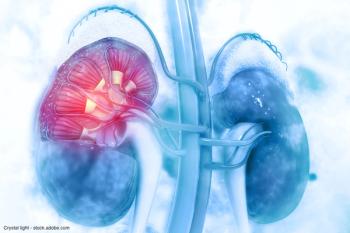
Tian Zhang , MD, discusses the adaptive phase 3 PDIGREE study comparing immunotherapy only versus immunotherapy/TKI regimens in patients with advanced kidney cancer.

Jordan J. Kramer, MD, discusses the background and findings of the study, “Statin use and lower urinary tract symptoms (LUTS) incidence and progression in reduction by dutasteride of prostate cancer events (REDUCE) trial.”
“I think the big findings are that men know about testicular cancer, but they may not know a lot and they feel like they could know more,” says Shawn Dason, MD.

“Ideally…we have a technology that's noninvasive that we can use in the clinic, where they don't require any anesthesia to…break the stones and make them smaller,” says Mathew D. Sorensen, MD, MS, FACS.

“Clearly, we are now in that era of TKIs in addition to checkpoint inhibitors, and so…it makes logical sense from the place we're at [in] the moment in renal cancer treatment with those combinations of treatment,” says Grant Stewart, MD.
“My opinion is that the practices that continue to utilize telemedicine moving forward after the pandemic are going to be the leaders in urology,” says Lisa J. Finkelstein, DO.

“The data…showed us that a lot of young [men]…are coming in for ED, and we can't really think of it as just a disease of older men…It can affect you at any age,” says Denise Asafu-Adjei, MD, MPH.

“What stood out for me in prostate cancer is the new imaging opportunities for patients with advanced prostate cancer or prostate cancer recurrence,” says Kelly L. Stratton, MD, FACS.

“This study was very important in that it showed cost savings with MOSES as well as the ability to reliably achieve same-day discharge,” says Matthew S. Lee, MD.

“I think the surgeon voice is an important voice to be heard because there's not a lot of avenues for surgeons to be able to be honest and share all the things they've learned and all the things they've experienced with their patients,” says Una Lee, MD, FPMRS.

In this interview, Melissa R. Kaufman, MD, PhD, FACS, describes the promise of a regenerative approach to treating recurrent incontinence in women known as autologous muscle derived cells for urinary sphincter repair (AMDC-USR).

“In short, there's a ton of missed opportunity to see how smoking affects treatments, especially in trial patients, and even in our patients that are in our clinics,” says Richard Matulewicz, MD, MS.

Among the highlights will be a talk from Senator Bill Cassidy, MD (R-LA).

As a committee, we felt that there was a need to put together a document to help field some of the ethical considerations that we run into in clinical care but have very little guidance on,” says Anne M. Suskind, MD, MS, FACS, FPMRS.

“One of the study findings that really stood out to me was that so many of the surgeons that we spoke to are…such strong advocates for their patients,” says Wai Lee, MD.
“Even factoring in the increased number of emergency room visits, there was still an overall cost savings of $747 in favor of the Moses HoLEP. So, that was surprising to see,” says Matthew S. Lee, MD.
"The focus of this study and the patient cohort that we're looking at are patients with intermediate-risk bladder cancer who [also have] low-grade bladder cancer. These patients [typically have] a lot of recurrences [and] multi-focal disease but are at low risk of progressing on to metastatic disease or developing invasion into their bladder wall,” says William C. Huang, MD.

“The world's a very, very small place and there are a lot of people who are hurting. It's our job as physicians to help relieve that discomfort, wherever it may exist, whether it's here in the United States or elsewhere, and this is the device that allows that to be realized,” says Ralph V. Clayman, MD.

Michel Pavic, MD, discusses how the combination of masitinib with docetaxel could be a new first-line treatment option for patients with metastatic castration-resistant prostate cancer.